The Benefits of Call Transcription for CX


Learn how call transcription in CX turns voice data into actionable insights that improve operational efficiency and drive custom satisfaction.

Learn how call transcription in CX turns voice data into actionable insights that improve operational efficiency and drive custom satisfaction.
Learn how Encore by ChorusCX unifies the 5 call recording types every contact center needs: compliance, QA, on-demand, screen capture, and analytics.
Forrester research shows that improving customer experience by even one point on their Index correlates with substantial revenue gains. The flip side is equally measurable, as low CX scores drive abandoned purchases, refund requests, and cancellations that affect your bottom line.When frustrated customers escalate to supervisors, handle times spike and expensive resources get consumed. Then those customers defect, and you’re left running costly acquisition campaigns to replace revenue you should have kept. PwC research found 33% of customers would switch after a single bad service experience, and acquiring a replacement costs up to 25 times more than retention. On the other hand, Bain & Co. research explains that a 5% increase in customer retention rates can boost profits by up to 95%.Chorus by ChorusCX tackles CX challenges at their source. The platform analyzes conversations in real-time and surfaces the right information precisely when agents need it, improving first-call resolution and reducing handle times. Its adaptive learning improves recommendations over time based on your organization’s actual interactions and outcomes.
Today’s digital landscape amplifies every customer interaction into potential brand-building or brand-damaging moments. Social media platforms and online review sites give dissatisfied customers immediate channels to broadcast their negative experiences to thousands of potential customers. Research shows online reviews influence the shopping choices of 98% of consumers, making reputation management more critical than ever.Research on negativity bias reveals that negative experiences are psychologically weighted more heavily than positive ones. According to relationship psychology research, a 5-to-1 ratio of positive interactions to negative ones is optimal for maintaining strong relationships. AI agent guidance technology ensures consistency across all touchpoints by providing real-time coaching that prevents reputation-damaging mistakes. When agents have immediate access to accurate information and proven response strategies, they deliver experiences that generate positive reviews rather than public complaints.
Contact center turnover averages 30-45% annually, impacted heavily by poor CX. Cornell research shows that 87% of contact center agents report high workplace stress, with 77% saying it affects their personal lives. Agents handling 50+ interactions a day without the right tools absorb customer frustration directly and eventually leave. Replacing a single agent costs $10,000-$20,000 once you factor in recruitment, training, and the productivity loss during ramp-up. Not to mention, traditional onboarding runs 4-6 weeks and requires constant refreshers. Without reinforcement tools, training deteriorates fast and the cycle repeats. Chorus breaks this cycle by delivering guidance in the moment, during live calls. Agents get relevant procedures and information contextually, without needing to recall weeks-old training. Best practices become consistent across your entire team regardless of tenure.
For a 100-agent contact center with 35% turnover, the math is straightforward: 35 agents × $15,000 replacement cost = $525,000 annually in turnover alone.But the full picture is broader:
Gartner research confirms that customer effort predicts loyalty more accurately than satisfaction scores alone. Organizations that measure effort alongside satisfaction know exactly where CX investment will generate the highest CX ROI on AI agent guidance technology.
Poor customer experience costs organizations millions in lost revenue, damaged reputation, and operational inefficiency. Every customer interaction is either building customer loyalty or driving them to competitors. The stakes are too high to rely on traditional training methods alone.ChorusCX Chorus gives agents real-time contextual information, proven response strategies, and step-by-step guidance during live calls. The results show up across every cost category: better first-call resolution, lower turnover, fewer escalations, and customer experiences that generate referrals instead of complaints.See Chorus in action.Request your personalized CX ROI analysis and demo to find out exactly what poor CX is costing your organization and what fixing it is worth.
A customer journey map is a visual representation of every experience your customers have with you. It tells the story of their experience from initial engagement into a long-term relationship. While marketing teams often use these maps to track buying behaviour, they are equally critical for customer service teams.When creating a customer journey map for a contact centre, you move away from looking at disjointed metrics like Average Handling Time (AHT) in isolation. Instead, you look at the entire lifecycle.A robust map typically covers these stages:
Perhaps most importantly, you must document every customer touchpoint. A touchpoint is any moment a customer comes into contact with your brand, whether that is navigating an IVR menu, reading an FAQ, or speaking to a customer service representative.
Why invest time in customer journey mapping? To start, understanding the path a customer takes allows you to smooth out the bumps in the road. However, the benefits extend far beyond process efficiency:
When you map out the journey, you often discover that customers are forced to repeat information or navigate complex routing systems. Identifying these bottlenecks allows you to streamline processes, leading to faster resolutions and lower effort for the customer.
Data-driven decision making replaces guesswork. If your map reveals that 80% of customers still end up calling even after checking your FAQ page, it’s clear that your self-service content needs work. Insights like these help you allocate resources where they make the most impact.
A journey map requires your organisation to look at processes from the outside in. It shifts the focus from “how do we close this ticket?” to “how can we best support this customer?”. Given this perspective, you can better align cross-functional teams and ensure that marketing, sales, and customer support are all pulling in the same direction.
Friction kills customer loyalty. But journey mapping highlights exactly where customers get stuck. For example, perhaps the roadblock is a confusing chatbot script or long hold times during peak hours. Once you have visibility into these roadblocks, you can remove them.
An effective map requires specific components to be actionable. You cannot simply draw a line from A to B; you must consider all nuances associated with the journey. Here’s what to identify as you build it out:
Not all customers behave the same way. You must define your customer personas, or semi-fictional characters representing your key audience segments. A tech-savvy millennial might prefer a chatbot, while an older demographic might prefer reaching out via phone. Your map should reflect these differences.
Your internal data only tells half the story. You must layer applicable customer feedback within your map. Customer surveys (CSAT, NPS) and direct feedback help you understand how customers feel at each stage. An example of this could be high churn at a specific touchpoint, as it signals a deeper disconnect.
Where does the journey break? Look for stages with high abandonment rates or frequent escalations. These are your critical pain points. If a customer consistently switches from a chatbot to a live agent in frustration, mark that transition as a friction point.
An omnichannel contact centre must ensure that every channel is included in the journey. This means accounting for social media, email, voice, SMS, and webchat. If you miss a channel, you miss a major piece of the puzzle.
Self-service options like FAQs, knowledge bases, and IVR menus are helpful for pointing customers in the right direction. But when these resources alone aren’t enough to solve the problem, customers are inclined to reach out for help. Understanding at which point customers transition from self-service to live support is how you can begin to optimize for greater efficiency.
Creating the map is one thing; ensuring it reflects reality is another. There are several strategic considerations to keep in mind as you map your contact centre environment to the customer journey.
It’s tempting to throw every piece of data you have into the mix. However, disparate, incomplete, or outdated data can lead you astray. Focus on high-quality, verified interaction data. If your CRM data is messy, clean it before you start mapping.
Customers show different behaviours and utilise different devices. That’s why you can’t map every single possibility immediately. Instead, prioritise the most critical paths, such as the “happy path” (ideal journey) and the most common “unhappy paths” (complaints or technical issues). Start there and expand your plan accordingly.
Creating your map should involve all key stakeholders, such as your support teams and frontline customer service reps. They have firsthand knowledge of where the journey fails and where it succeeds — which is far more reliable than acting on instinct or assumption.
Customers do not see channels; they see one brand. If your map treats email and voice as separate universes, it’s fundamentally flawed. You must understand how a customer moves between channels. Whether a journey starts on social media or a simple phone call, your map must reflect this fluidity.
ChorusCX Chorus acts as the critical engine room for your mapping efforts. It provides the integrated data, visibility, and cross-touchpoint continuity required to improve CX and build a personalised experience.Here is how Chorus enables practical, customer journey mapping:
Chorus centralises communications like voice, messaging, chat, and Microsoft Teams calls into a single platform. This ensures every interaction updates one unified record. Moreover, accurate journey maps require a complete history, and Chorus allows you to see the full sequence of events rather than siloed snapshots. In turn, you reduc data gaps that lead to inaccurate maps.
Chorus includes advanced reporting and sentiment analysis tools. These features help you quantify how customers move through your ecosystem. AI-powered analytics reveal intent and sentiment at each stage, allowing you to spot patterns, such as where customers repeatedly escalate issues. You can then use these insights to validate or redesign your journey maps based on real behaviour.
Routing decisions are a key part of the journey. Chorus uses intelligent routing to direct customers based on their history and preferences. This ensures the journey flows logically. By measuring how routing impacts outcomes, you can design more predictable and lower-friction paths for your customers.
Chorus ensures that context travels with the customer. If a customer switches from phone to chat, they do not have to repeat themselves. For journey mapping, this is critical. It means you can trace a continuous path rather than a fragmented one, making it much easier to identify exactly where a journey breaks down.
Operational factors heavily influence the customer journey. Chorus provides tools for workforce optimisation and quality monitoring. This connects agent performance to customer outcomes, revealing internal bottlenecks — like training gaps or scheduling issues — that could negatively impact CX.
Learn why more and more contact centres are choosing ChorusCX Chorus and explore these five benefits.
A customer journey map is only as good as the data that powers it. To truly become customer centric, you need a unified view of your interactions.ChorusCX Chorus provides the integrated omnichannel data, real-time analytics, and operational context necessary to turn a theoretical map into a practical tool for improvement. With this foundation, you can move beyond assumptions and start creating a customer journey that builds long-term loyalty. See why data-driven, customer-centric design is key to improving contact centre performance and schedule a demo with ChorusCX today.
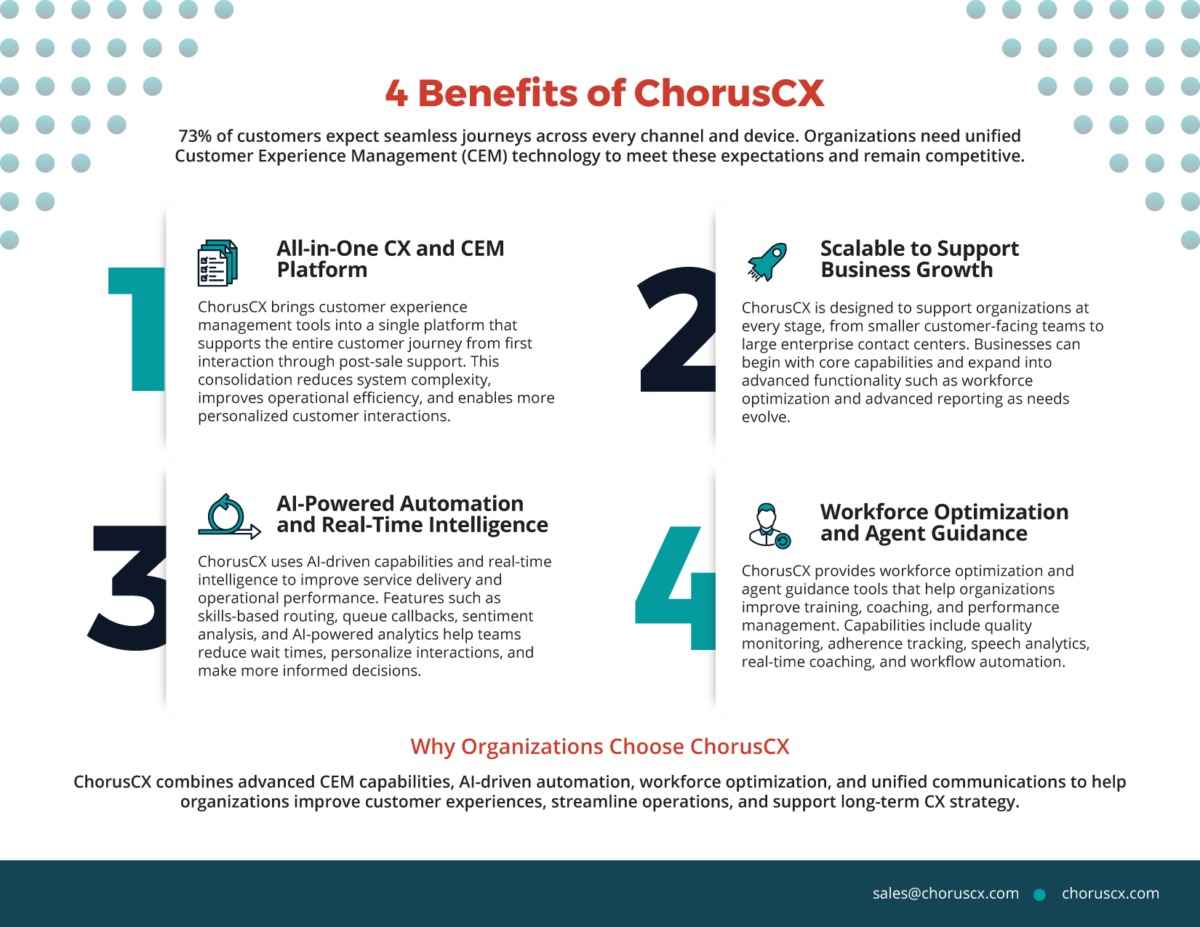
73% of customers expect seamless journeys across every channel and device. Organizations need unified Customer Experience Management (CEM) technology to meet these expectations and remain competitive.
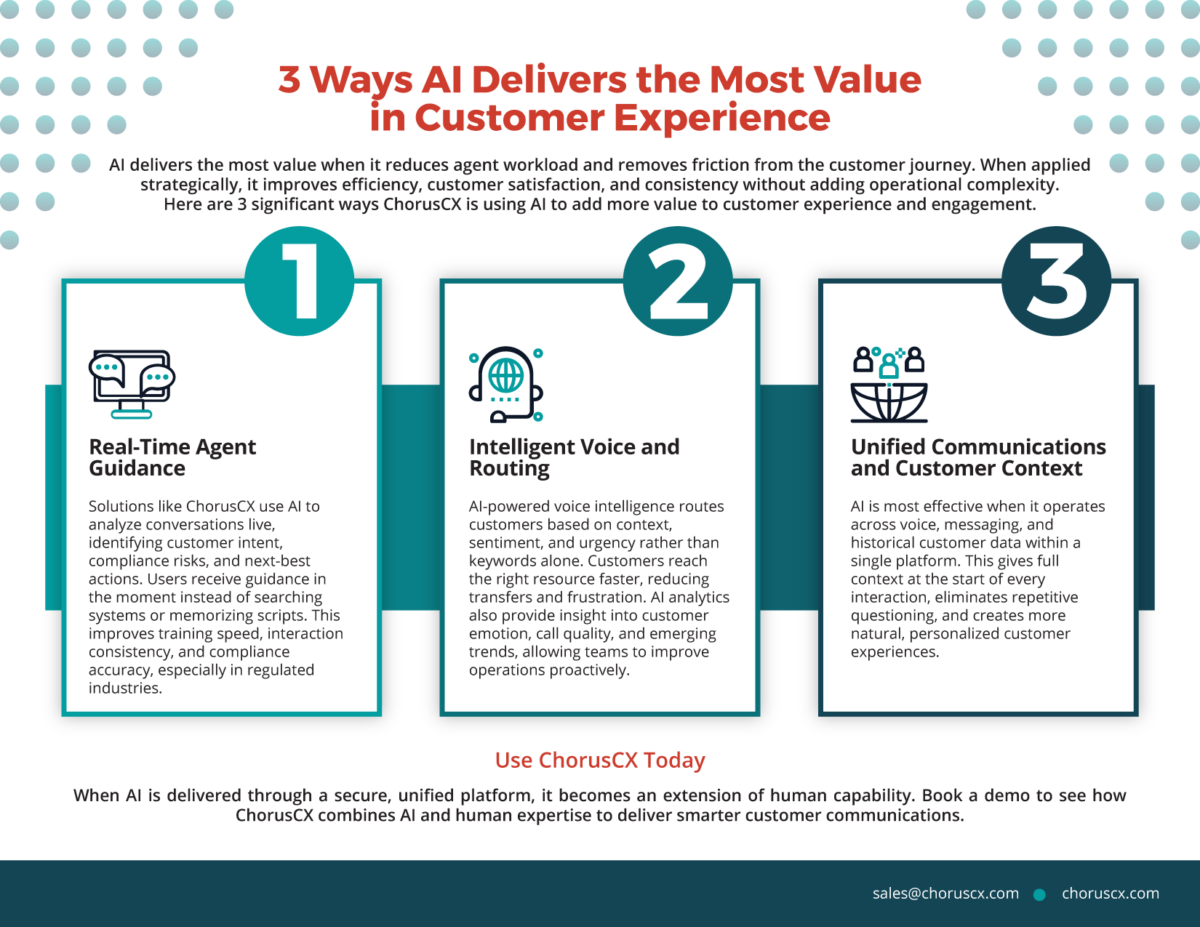
Here are 3 significant ways ChorusCX is using AI to add more value to customer experience and engagement.
Here are 5 common challenges organizations face with customer experience and how ChorusCX solves them.
Relying on fragmented tools and systems creates a disjointed customer experience, which undermines trust, slows down sales cycles, and leads to valuable opportunities falling through the cracks. Furthermore, customers become frustrated, and your sales team struggles to maintain momentum. In contrast, the unified data and consistent interactions provided by Chorus create a predictable and positive CX journey. When every touchpoint is connected, you see fewer customer drop-offs and more predictable outcomes with each interaction.
Chorus’s unified CX solutions provide several levers to accelerate your sales and drive revenue growth:
Today’s buyers interact with businesses across multiple channels. Chorus’s omnichannel capabilities ensure your team has full context of every interaction, whether it’s a call, email, chat, or social media message.
As a result, potential customers don’t have to repeat themselves and reps can reduce friction and speed up a customer’s decision to buy. Offering this smooth, consistent experience builds trust and leads to higher conversion rates, better lead follow-through, and less customer churn.
Using AI-driven, skills-based routing, prospects are instantly connected to the team member best equipped to handle their specific needs. With the right person available at the right time, you can shorten sales cycles and improve first-contact resolution. Meanwhile, real-time analytics and sentiment analysis tools help your team members detect buying signals during conversations, allowing them to prioritise high-value opportunities and tailor their approach for maximum impact.
Your customer service reps are on the front line of your sales efforts, and Chorus equips them with the tools and data they need to succeed. Tools like real-time agent guidance, advanced call analytics, and quality monitoring help improve performance with every interaction.
Additionally, an integrated knowledge base provides instant access to product or service information — a tool that is invaluable for reducing training time — while automated workflows help reps respond faster and more accurately. In turn, teams can have effective sales conversations while having all the information they need to personalise offerings.
Closing a deal often requires input from multiple departments. With its deep integration with platforms like Microsoft Teams, Chorus simplifies cross-team communication and breaks down internal barriers. Unifying internal communication keeps your sales team productive while ensuring better coordination for upsell and cross-sell opportunities. Moreover, it allows sales reps to quickly collaborate with product experts or support staff to resolve customer queries without delay — which is a key advantage for driving customer retention.
Data is crucial for refining any sales process, as it allows teams to identify high-value prospects and untapped areas for upsell and cross-sell opportunities. That’s why Chorus provides powerful reporting and advanced analytics that offer deep insights into customer behaviour, interaction patterns, and operational bottlenecks. Sales leaders can use this information to optimise scripts, fine-tune workflows, and forecast revenue more accurately. With the ability to turn this data into actionable strategies, you can make smarter business decisions that improve pipeline quality and boost sales.
Here are a few tips for getting started with ChorusCX Chorus:
Chorus gives you the tools to turn every interaction into a revenue opportunity. Schedule a demo today to learn how our solutions help strengthen lead generation, boost sales, and maximise value with new and existing customers.
Your customers are tired of being treated like strangers. Seventy-three percent expect you to already know their needs, yet your fragmented systems force them to repeat their story over and over. Beyond customer experience, the impact of this disconnect hits your business in three critical areas: Wasted Agent TimeWhen customer information, purchase history, and support tickets are located in separate applications, agents waste 4-6 minutes per call just switching between applications and asking customers the same questions. That’s nearly an hour of lost productivity per agent per day. This is time that could be spent actually solving problems instead of hunting for basic information. Multiply that across your entire team, and you’re looking at hundreds of wasted hours every week.Cognitive OverloadStudies show the average user toggles between applications and websites nearly 1,200 times a day, and that repeatedly switching between tasks triggers a stress response in the brain as it requires employees to shift cognitive contexts.Data locked away in CX silos prevents marketing from knowing about support issues, sales from following up on service complaints, and product teams from hearing feedback patterns. You end up with mixed messages, wasted effort, and problems that keep frustrating customers until they leave.
When a customer who’s been loyal for years is calling about a big purchase and has already spoken with support twice this week, your team needs that full context immediately. They should be able to see the customer’s history, recognize the urgency, and escalate to someone who can resolve the issue on the first call. Without a unified view, that valuable customer gets treated like a stranger, forced to repeat their story, transferred between departments, and left frustrated. Companies lose 67% of customers due to poor service experiences, and siloed systems are often the root cause. By ignoring these gaps in information, you risk your most loyal customers becoming your competitors’ newest acquisitions.
A customer experience hub transforms your call center from a place that just handles complaints into a source of real business intelligence. Instead of working in isolation,CX hubs integrate customer data, technology, and processes, providing a 360-degree customer view throughout the entire relationship. When your organization understands how customers actually experience your business, you can fix problems before they turn into crises. Three elements distinguish a true CX hub from a traditional contact center: unified data, connected technology, and cross-department collaboration.
It starts with unified customer experience data. Contact center integration platforms pull together everything from sales calls, support tickets, chat logs, social media conversations, and purchase records into one place anyone can access. When a customer reaches out through any channel, agents can see the entire customer support journey without playing twenty questions.Connected Technology and WorkflowsThe technology piece goes deeper than just data. Cohesive infrastructure like Chorus by ChorusCX links intelligent voice systems, agent guidance platforms, analytics, and your business apps into workflows that actually make sense. Cloud communications make this possible while giving you room to grow.Cross-Functionality Between DepartmentsTry replacing clunky handoffs between departments with workflows everyone shares. Companies that break down CX silos increase customer lifetime value by 1.6 times and grow their revenue 1.4 times faster than competitors still working in boxes. When teamwork improves, customer satisfaction improves. Customers who don’t have to repeat themselves are 2.4x more likely to remain loyal to your brand. Stop measuring just department efficiency and start tracking things that matter to customers, like how fast you solve their problems and whether they’re actually satisfied.
Organizations across healthcare, financial services, and insurance have leveraged Chorus to streamline operations and improve both agent efficiency and customer satisfaction. This is especially valuable for industries where regulations are complex and accuracy matters.So what makes a CX hub work? The foundation is built upon unified, cloud-based systems, real-time agent guidance and intelligence, and customer experience analytics.
Cloud-based communications platforms get rid of the technical walls between departments. Old on-site systems treat phone, email, and chat like separate planets. Unified cloud platforms route everything through connected channels that your whole authorized team can access.Hybrid cloud setups work well if you have particular security or compliance needs. Keep sensitive data on your servers while letting communication tools run in the cloud. You get strong security without giving up the connections that eliminate CX silos.
Agent guidance technology changes how your frontline staff use company knowledge. They don’t need to memorize every policy or dig through five different systems anymore. Instead, they get real-time prompts, ready-made responses, and smart suggestions based on who they’re talking to and what your business needs.Chorus does exactly this by listening to conversations as they happen and pulling up the right information at the right moment. It connects to your databases, knowledge libraries, and CRM without agents having to click around manually.
Good analytics platforms stop treating each interaction like an isolated event. Rather than analyzing phone calls, emails, and chats separately, unified systems track complete customer journeys to spot patterns, understand preferences, and find opportunities. These insights help you resolve issues before they become critical. When your system notices a customer struggling with a feature, it can automatically send helpful content, schedule a check-in call, or route their next contact to someone with specialized knowledge. You don’t need someone manually watching for these patterns because the technology handles it for you. Chorus enables your agents to spend time helping customers instead of hunting for information.
While competitors struggle with fragmented systems, you can leap ahead with the right platform. But getting rid of customer experience silos requires the best CX technology solutions that actually bring together your data, channels, and teams. ChorusCX provides complete CX technology solutions that turn old-school customer service operations into strategic, omnichannel hubs, empowering your business with intelligent voice systems, real-time agent guidance, and cloud communications that scale from 10 to 10,000 agents without replacing your infrastructure.Request a demo todayto see how Chorus can transform your siloed service operations into an integrated customer experience hub while saving your team valuable time.
[fusion_builder_container type=”flex” hundred_percent=”no” equal_height_columns=”no” menu_anchor=”” hide_on_mobile=”small-visibility,medium-visibility,large-visibility” class=”” id=”” background_color=”” background_image=”” background_position=”center center” background_repeat=”no-repeat” fade=”no” background_parallax=”none” parallax_speed=”0.3″ video_mp4=”” video_webm=”” video_ogv=”” video_url=”” video_aspect_ratio=”16:9″ video_loop=”yes” video_mute=”yes” overlay_color=”” video_preview_image=”” border_color=”” border_style=”solid” padding_top=”” padding_bottom=”” padding_left=”” padding_right=””][fusion_builder_row][fusion_builder_column type=”1_1″ layout=”1_1″ background_position=”left top” background_color=”” border_color=”” border_style=”solid” border_position=”all” spacing=”yes” background_image=”” background_repeat=”no-repeat” padding_top=”” padding_right=”” padding_bottom=”” padding_left=”” margin_top=”0px” margin_bottom=”0px” class=”” id=”” animation_type=”” animation_speed=”0.3″ animation_direction=”left” hide_on_mobile=”small-visibility,medium-visibility,large-visibility” center_content=”no” last=”true” min_height=”” hover_type=”none” link=”” border_sizes_top=”” border_sizes_bottom=”” border_sizes_left=”” border_sizes_right=”” first=”true”][fusion_text]
There is a growing demand for scalable contact centre software and integrated collaboration tools that allow businesses to punch above their weight. Small and medium sized enterprises (SMEs) in particular face a tough balancing act when it comes to their communication systems.
Beyond the need to compete with larger corporations, SMEs often work with fewer resources and tighter budgets. One area where this disparity often shows is in their communication technology. Teams may struggle with fragmented phone systems or toggle endlessly between disparate messaging apps and video tools, making it difficult to hit service-level agreements (SLAs).
If your infrastructure costs are rising while efficiency dips, it is time to rethink your strategy. Learn how modern unified communications platforms like that of ChorusCX remove the cost of maintaining on-premises hardware while dramatically simplifying daily operations.
Unified Communications as a Service (UCaaS) is the answer to the fragmentation problem. But what does it actually do? Simply put, UCaaS brings together voice, instant messaging, video conferencing, and file sharing into a single, cloud-based environment.For SMEs, the core benefits of UCaaS include:
The cloud model offers predictable subscription pricing, eliminating shock repair bills. It also offers incredible scalability; you can easily add or remove licenses and users as your business changes.Moreover, moving to the cloud removes the need for expensive, on-premises hardware and dedicated maintenance. In fact, 82% of businesses report savings after moving to the cloud. With the ability to consolidate your phone system with key collaboration tools, you gain operational efficiency that directly impacts your bottom line.
ChorusCX delivers these benefits through our innovative SmartUCaaS offering with our Chorus product suite, which provides wrap-around services to support a smooth transition. It is designed to enhance the customer experience at every step while significantly reducing complexity for SMEs with limited IT resources.SmartUCaaS brings multiple channels into one user-friendly application, including:
Not every business is ready to jump 100% into the public cloud immediately. This is where hybrid-cloud communication solutions can be especially helpful, as they allow you to combine the flexibility of the cloud with your existing business infrastructure. The hybrid cloud is ideal for multi-site SMEs, regulated environments that need specific on-site data controls, or businesses that want to upgrade gradually from outdated systems to the Avaya IP Office Subscription. With ChorusCX, you get the best of both worlds: greater reliability and system innovation.
Work is no longer a place you go; it is something you do. ChorusCX’s solutions for SMEs extend far beyond the office walls. To support a truly productive remote workforce, we offer tools that ensure consistency regardless of location.Our platform manages costs, users, and security through a single portal. Additionally, our Agent Ready app is designed specifically for remote contact centre software users, ensuring they have the same capabilities at home as they would in the office. Now, distributed teams can collaborate effectively without sacrificing service quality.
Customers today expect you to know who they are when they call, making customer relationship management (CRM) platform integration crucial. With the ability to connect your UCaaS platform with your customer relationship management tools, you provide your team with immediate customer context, resulting in:
With ChorusCX, small and medium sized enterprises (SMEs) gain access to enterprise-grade unified communications and customer experience capabilities without the cost or complexity of multiple systems. ChorusCX Chorus brings Smart UCaaS, contact centre software, collaboration tools, and advanced CX features into one cohesive platform with an easy-to-manage environment.Backed by flexible deployment options, open integrations, and end-to-end migration support, Chorus’s solutions enable SMEs to streamline communications, improve customer experience, and support scalability. Contact ChorusCX today to see how Chorus’s can modernise your business communications.
[/fusion_text][/fusion_builder_column][/fusion_builder_row][/fusion_builder_container]