Why CX Is No Longer a Support Function – It’s a Growth Strategy

For most of the past two decades, the contact center sat in a neat organizational box labeled “operations” or “customer support.” It was a necessary cost, something to manage efficiently and keep from becoming a liability. The goal was handling volume at the lowest possible cost per contact.

That model is over.

In 2025, 96% of company leaders say their leadership team views CX as a key driver of business outcomes (Nextiva, 2025). That’s not a nuanced shift in perspective, it’s a wholesale repositioning of what customer experience means to a business. The organizations that understand this are outgrowing the ones that don’t.

Companies focusing on CX experience 80% faster revenue growth and 60% higher profits than CX laggards (Zendesk). Here’s the case for treating CX as a core growth function, and what it means practically for how you operate.

The Old Model: CX as Cost Center

The traditional framing of customer service was fundamentally defensive. You invested in it to prevent catastrophe: to stop churn from getting worse, to manage escalations, to maintain a baseline of acceptable service. Budget conversations centered on cost per contact, headcount ratios, and SLA compliance.

In this model, customer experience was the department that fixed problems other parts of the business created. It was reactive, downstream, and perpetually underfunded relative to sales and marketing.

The data says this was always wrong, we just didn’t have the analytics to prove it.

The New Reality: CX Drives Revenue Directly

Multiple research bodies have now established the revenue connection clearly. Bain & Company found that a 5% increase in customer retention can increase profits by 25–95%,  and retention is a CX output. Forrester found that companies with strong CX strategies see 1.5x higher revenue growth and 1.8x higher profitability. PwC found that customers are willing to pay up to 16% more for a superior customer experience, making CX a literal pricing lever. Gartner reports that 89% of businesses now compete primarily on customer experience rather than product or price. And Emplifi found that 61% of customers will spend at least 5% more when they know they’ll receive a good experience.

These aren’t soft metrics. They’re direct financial impacts. And the organizations that have restructured their operations around them are seeing results that can’t be explained by product improvement or sales tactics alone.

What Changes When CX Is a Growth Strategy

1. The Metrics Change

Cost-center CX is measured on AHT, handle volume, and budget efficiency. Growth-strategy CX is measured on customer lifetime value, net revenue retention, churn rate by touchpoint, and revenue influenced by CX improvements.

This isn’t just a reporting change, it changes what decisions get made. When your contact center is accountable for CLV, every scheduling decision, every training investment, and every technology choice gets evaluated differently. Nextiva’s 2025 survey found that 47% of CX leaders say the ability to track the revenue impact of CX investments is what finally earned them favorable executive attention. The analytics unlocked the budget.

2. Investment Decisions Change

CX leaders who can demonstrate revenue impact have fundamentally different budget conversations. Instead of defending operational costs, they’re presenting ROI cases.

The returns are there. Companies implementing AI customer service see average returns of $3.50 for every $1 invested, with leading organizations achieving up to 8x ROI (Zendesk). Organizations with mature CX programs achieve 5.1x revenue growth compared to beginners (Onramp). When your CX program is measured as a cost center, you fight for scraps. When it’s measured as a growth function, you fight for investment.

3. Cross-Functional Collaboration Changes

Cost-center CX teams receive problems from the rest of the business. Growth-strategy CX teams send intelligence back.

Every conversation your agents have is a data feed: what customers misunderstand about your product, where competitors are winning, what features customers most want, what policy changes are generating friction. Contact centers sitting on this intelligence and not synthesizing it into actionable feedback are missing one of their most valuable contributions.

The best CX organizations have formalized feedback loops, regular sessions with product, marketing, and sales where contact center data drives roadmap decisions and campaign refinements. Nearly 74% of organizations are increasing their CX investments, but only 25% of customers say they were “very satisfied” with their last service interaction. That gap is where the opportunity lives.

4. The Technology Stack Changes

Managing a cost center requires workforce scheduling software and a ticketing system. Managing a growth function requires unified CX platforms that connect interaction data to customer health scores, revenue signals, and predictive analytics.

The shift to viewing CX as growth is also driving consolidation of the CX technology stack. Companies running 6–7 separate tools for customer interactions are replacing fragmented point solutions with integrated platforms that give leaders a unified view across every customer touchpoint.

5. Talent and Culture Change

Cost-center agents are trained to resolve tickets efficiently. Growth-strategy agents are trained to deepen customer relationships. They understand product value, they know when to upsell and when to listen, and they have the authority to make decisions that serve the customer’s long-term interest.

Forrester found that companies prioritizing employee experience alongside CX report 1.8x higher revenue growth rates. The chain is direct: empowered employees deliver better experiences, which drives customer loyalty, which drives revenue.

How to Make the Shift

Moving CX from a cost center to a growth function requires both operational and cultural change.

Start by connecting CX metrics to revenue metrics, build a dashboard that shows CLV, NRR, and churn alongside CSAT and AHT. Then present CX investments as ROI cases: quantify what a 1-point improvement in FCR is worth in reduced repeat contacts and improved retention. Build feedback loops with product, marketing, and sales, and formalize the channel for contact center intelligence to influence the business. Invest in your agents’ capabilities by training for relationship skills, not just resolution skills. And consolidate your CX platform, fragmented tools produce fragmented insight, and unified platforms produce unified growth strategies.

The contact center was never really a support function. It was always the place where your customers’ real relationship with your company played out, where trust was built or broken, where loyalty was earned or lost. Organizations that have started measuring it that way are growing faster than those that haven’t.

The question isn’t whether CX is a growth strategy. The question is whether your organization is positioned to treat it as one.

Chorus CX is built for organizations that take customer experience seriously as a growth driver. Learn more at choruscx.com
CX Module

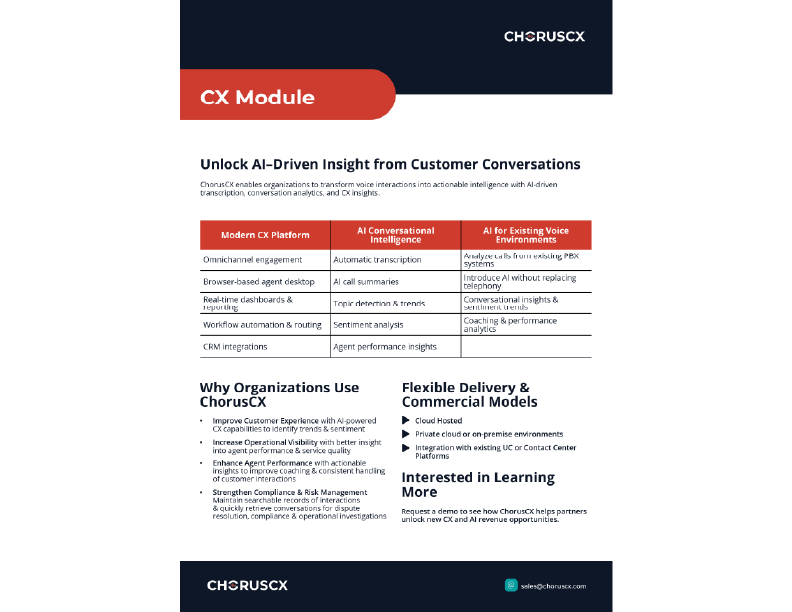
ChorusCX enables organizations to transform voice interactions into actionable intelligence with AI-driven transcription, conversation analytics, and CX insights.

Download PDF

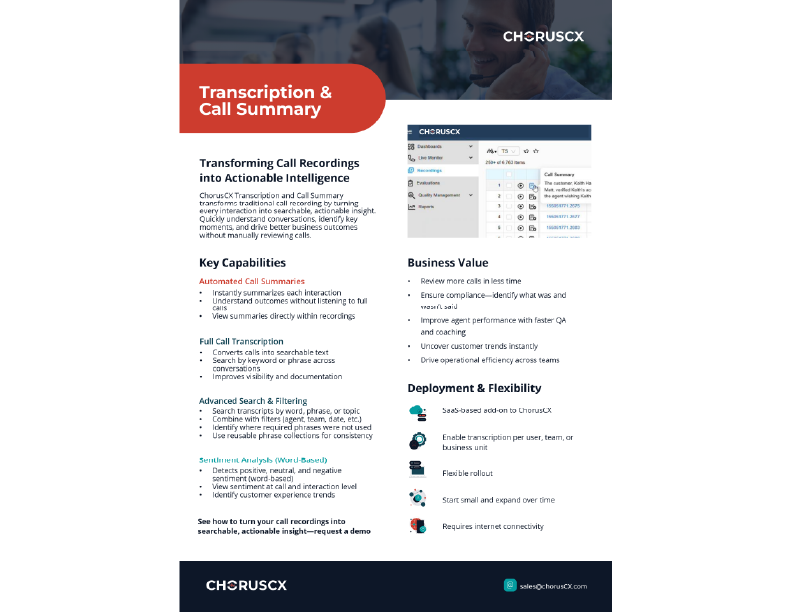
Transcription & Call Summary

ChorusCX Transcription and Call Summary transforms traditional call recording by turning every interaction into searchable, actionable insight. Quickly understand conversations, identify key moments, and drive better business outcomes without manually reviewing calls.

Download PDF

Workforce Management

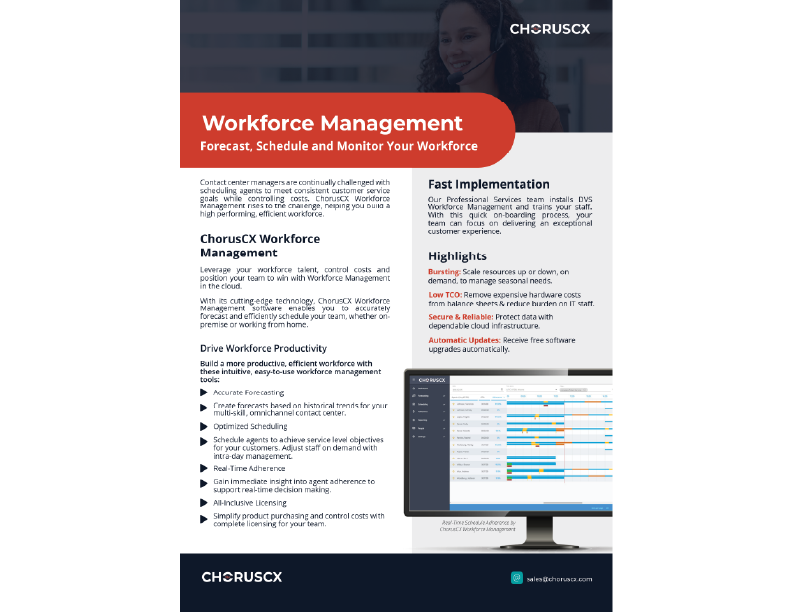
Contact center managers are continually challenged with scheduling agents to meet consistent customer service goals while controlling costs. ChorusCX Workforce Management rises to the challenge, helping you build a high performing, efficient workforce.

Download PDF

ChorusCX Employee Spotlight: Jason Moravec

At ChorusCX, our people are at the heart of everything we do, and we’re excited to highlight Jason Moravec, a seasoned channel leader with a passion for building partnerships and driving growth.

Meet Jason

Jason Moravec is originally from Chicago, Illinois, most recently based in Salt Lake City, Utah, and is preparing for an exciting relocation to the United Kingdom as he continues to expand his career on a global scale.

Role at ChorusCX

As Channel Team Lead, Jason is responsible for leading and developing ChorusCX’s channel and partner sales strategy. His day-to-day includes managing partner relationships, driving the ChorusCX messaging strategy, and mentoring the channel sales team to deliver impactful results.

Industry Background

Jason brings nearly a decade of experience in telecommunications, specializing in unified communications (UC) and contact center solutions. He has held key roles at organizations like RingCentral, where he led the Avaya Cloud Office (ACO) partnership, and Xima, where he led channel initiatives for CCaaS and contact center solutions.

What Drives Him

Jason thrives on collaborating with partners and customers to develop strategies that truly enhance their businesses. He finds it rewarding to help organizations unlock new potential through the right solutions. At ChorusCX, he’s especially excited to leverage his experience to further strengthen partnerships, refine channel strategy, and grow within the UK market.

Key Strengths

  • Leadership and team development
  • Sales strategy and positioning
  • Relationship building
  • Problem solving and strategic thinking

What Makes Jason Successful

Jason attributes his success to his competitive drive and natural leadership mindset, which fuel his ability to push initiatives forward and inspire those around him.

Outside of Work

When he’s not leading channel strategy, Jason enjoys spending time with his family and staying active. His hobbies include hiking, biking, off-roading, traveling, playing video games, and sports.

We’re thrilled to have Jason on the ChorusCX team and look forward to the impact he’ll continue to make as we grow our global partner ecosystem.

Introducing ChorusCX: One Platform. Infinite Possibility.

We’re excited to officially announce our new company: ChorusCX. ChorusCX combines three long-standing organizations, Invosys, DVSAnalytics, and Infinity CCS, to form one unified, global platform, bringing together decades of expertise and a shared vision for what customer experience should look like.

ChorusCX brings customer experience, intelligent cloud networks, contact centers, and AI technology together into a single platform, so businesses no longer have to manage multiple vendors and disconnected tools to serve their customers. ChorusCX covers everything from guidance and knowledge tools, productivity management, and unified communications, to omnichannel CX, number management, and fully managed services, all designed to work together and deliver measurable results.

Organizations that invest in ChorusCX get a simpler technology stack, stronger operational efficiency, and the AI capabilities needed to meet rising customer expectations without increasing complexity. The result is better customer experiences, more productive teams, and a clearer return on investment.

“This is such an exciting moment for all of us. We’re bringing together three brilliant teams and a huge amount of combined expertise to build something that genuinely moves the needle for our customers and expands solution sets for our partners,” said Jane Anderson, CEO, ChorusCX. “The people and relationships our customers and partners value aren’t going anywhere.  If anything, they’re getting stronger. I’m incredibly proud of what we’re creating together with ChorusCX.”

For our existing customers and partners, the most important thing to know is that the teams you’ve built relationships with are staying. Your support contacts, your account teams, partner managers, the people you pick up the phone to, they’re all still here, and with this new combined business behind them, they’ll be better resourced and more capable than ever before.

If you have any questions, please don’t hesitate to reach out to your existing account team or contact us directly at choruscx.com. We’re here to help, and we look forward to continuing to work with you under this exciting new chapter.

Case Study: CIMB

CIMB Bank Berhad’s London branch primarily supports corporate and commercial clients, offering services such as corporate loans, deposits, treasury products, and advisory on fixed income, foreign exchange, and money markets.

Download PDF

Case Study: Telephonic Signature

The State of California requires county-level Health and Human Services agencies processing telephone applications for Medi-Cal to record a “Voice Attestation” during the application process. This recorded segment must be available to send to the State as requested for legal reasons. • Record a “Voice Attestation” that can be sent to the State • Voice Consent must be easy to locate, retrieve and play • Required the option to trigger the Voice Signature by the recording system • Voice Signature recordings must be retained for a specific time, separate from the audio recording

Download PDF

Case Study: VCU Medical Center

Located in Richmond, Virginia, the Virginia Commonwealth University (VCU) Medical Center offers virtually every form of contemporary medical service and is the region’s only Level 1 Trauma Center for adults and children. Being a large-scale medical facility, VCU receives numerous calls each day to schedule outpatients, order room service, admit patients, transfer patients and so much more. Adding even more complexity to the contact center environment, these calls are answered by employees in different clinics, departments and programs. As the only academic medical center in the region, VCU Medical Center is on the forefront of health care, providing patients with the most progressive treatments and medical technology available.

Download PDF

Case Study: Cobb EMC

As a not-for-profit, member-owned electric cooperative, Cobb EMC safely delivers reliable electricity to nearly 200,000 residential and commercial consumers in the Georgia counties of Cobb, Bartow, Cherokee, Fulton and Paulding. The organization is consistently recognized for competitive rates, commitment to renewable energy, and giving back to the communities it serves.

Cobb is one of the largest EMCs in the nation and the company’s wholly-owned subsidiary, Gas South, is a leading provider of natural gas in the Southeast.

Download PDF